- Published on
Exegesis Part One - there's a ring to it
- Authors
- Name
- Lorselq
- @lorselq
Pulling a string for a theory
When I try to explain Enochiana and all it entails to those unfamiliar with the topic, there's no shortage of difficulty in determining where to start. Not only are there two merging and diverging worlds—the academic and the esoteric—even within the worlds, many of the parts are interconnected in complex and unexpected ways.
A tangled ball of string, if you will.
Ostensibly, the string is just one piece, and like yarn in a crocheted sweater, pulling at one of its ends will eventually unravel and lay bear the essence of the whole thing. In the 20th and 21st century, people have made an incredible amount of progress picking it all apart (especially on the esoteric side).
To level with you, my introduction to Enochiana was through the esoteric side—and while I currently am immersed in a heavily academic project surrounding the Enochian language—the end of string I'm best equipped to tug at is the esoteric one.
But again—where does one even start??
I've made an image that sums up the pieces pretty well:
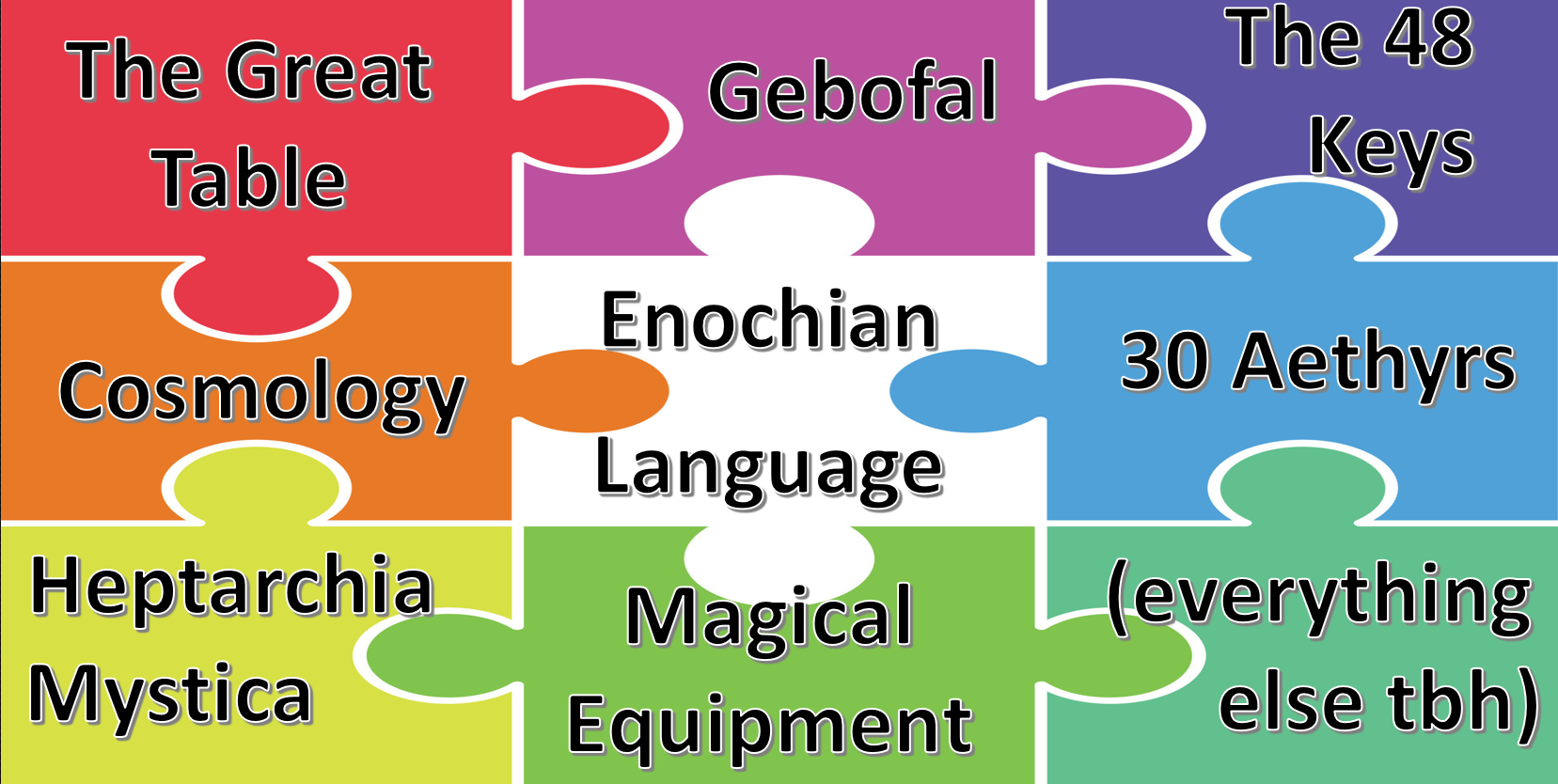
I put "Enochian Language" in the middle because everything—the whole of Enochiana—ties back to it. To be fair, I might be biased because I am a little obsessed with it.
There are a lot of good esoteric primers on the Heptarchia Mystica, the Great Table (and Tabula Recensa), the 30 Aires or Aethyrs. Which, to be fair, this makes sense because this is where most of the occult workings that people engage in nowadays come from.
Most esoteric authors, from what I've seen, give historical context and follow with talking about the Magical Equipment. I think this is reasonable—Dee and Kelly received guidance about the furniture first. While there is no shortage of puzzles to explore with the equipment they received—especially the Sigillum dei Aemeth, the Holy Table, the Lamen—one that has garnered some attention, but not tons, is the ring.
Before I get into talking about the ring, let me be very clear: if I'm correct, the entirety of Enochian cosmology can be summarized through unpacking symbolism contained within the PELE ring!
tHE pele RING: a case of confused cases
Before going through quote after quote of how this thing is constructed, I'm going to just start with an image. That way, you can look at the quotes and go, "Yeah I guess that's what it's doing."
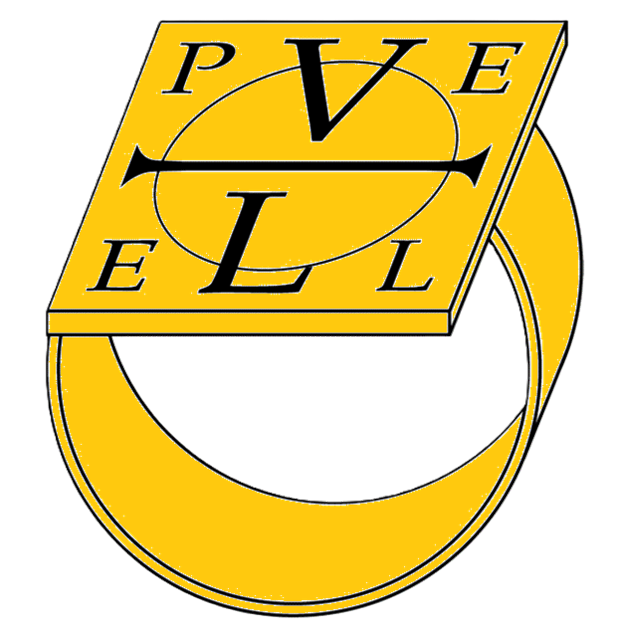
Anyway, I present to you the PELE ring!
So let's start with some things we don't know:
- We don't know how "PELE" is pronounced
- It could be pee-lee, like an orange peel-esque descriptor
- It could be pay-lay, like you're purchasing a reservation to nap at a place
- It could be peel or pail, or a bucketful of other options
Most of the people I've heard say it aloud say "pay lay ring," so hopefully that counts for something. I know hearing how things are said helps me grok the word better.
Anyway, another name for it could be Solomon's ring, but it's not called that because there are a lot of traditions that have different ring designs that the tradition claims Solomon wore, and rather than confusing it with all the other Solomon's rings, this one gets to be the PELE ring because it's the only one that says PELE on it.
We know this because the angels said so very explicitly:
And had these fowre letters in it, P E L E.
But I'm getting ahead of myself—here's an excerpt from Dee's diaries where one of the angels communicated the ring's nature to him.
I will reveale thee this ring: which was never revealed since the death of Salomon: with whom I was present. I was present with him in strength, and mercy. Lo, this it is. This is it, wherewith all Miracles, and diuine works and wonders were wrowght by Salomon: This is it, which I haue revealed unto thee. This is it, which Philosophic dreameth of. This is it, which the Angels skarse know. This is it, and blessed be his Name: yea, his Name be blessed for euer.
The angels emphasized the ring's necessity:
Without this, thow shalt do nothing. – Blessed be his name, that cumpasseth all things: Wonders are in him, and his Name is WONDERFVLL : His Name worketh wonders from generation, to generation.
So yeah, the ring is a big deal here.
And even so, there are still a lot of unanswered questions. What's a PELE? What's with the "V" and the "L" and the line and the circle?
What's a PELE?
The name is an easy one (sort of)—it's apparently a name of God. Per the Renaissance occultist named Cornelius Aggripa in chapter XI, book 3 of the Three Occult Books of Philosophy:
... and in the book of Judges the Lord saith, "my name which is PELE פּלא", signifieth with us, a worker of miracles. or causing wonders...
You may have noticed that the Hebrew lettering provided is just Peh Lamed Aleph. This is a perfectly valid way to write PELE, and is actually pretty standard. However, when making a magical ring with a square face, three letters just doesn't cut it—like, do you want an empty space in the bottom-left when you've run out of letters?
The angels very explicitly gave the spelling "PELE", so what do? Well, there's another reconstruction that has been posited by Scott Michael Stenwick, where you use the letters Peh Heh Lamed Heh instead of the more standard Peh Lamed Aleph—so basically this: פּהלה. Using Heh as a stand-in for "E" is justifiable because it the Phoenician letter that became our "E" originally had a consonant sound like "H" in "hat".
Whether Dee or Kelly would have known about the Phoenician connection is unclear. For that matter, allegedly neither Dee nor Kelly were deeply familiar with Hebrew.
Either way, for sake of argument, let's assume Peh Heh Lamed Heh—three letters doesn't work, four is more aesthetically pleasing and looks more correct on a square ring. But like... why does it matter?
Stenwick points out that this sequence of Hebrew letters has a special value when added together.1 When added together, Peh is 80, Heh is 5, Lamed is 30, and Heh is 5 again: which equals 120.
120, in turn, can be factored into 2 times 6 times 10, which represents the union of Chokmah (the second sphere on the Qabalistic tree of life, which can represent the Zodiac), Tiphareth (the sixth sphere on the tree of life, which represents the Sun and, in virtue of being such, can stand in for all the other astrological planets), and 10, which is Malkuth (which represents the physical, material plane of existence—terra firma).
Which is to say, PELE is a stand-in for all of existence. This will be relevant later.
The quasi-letter-y things and shapes
As far as the rest of the ring's construction: within PELE is circle, a horizontal line through it, a "V" shape piercing the circle at the top, and an "L" shape piercing the circle from the bottom.
Let's start with the circle and the line. Stenwick initially theorizes that the circle with the line through it could be an alchemical symbol for salt (or a variant thereof) or maybe a simple glyph representing Saturn, but then speculates without subsequent explanation that the best explanation may come from Dee's Monas Hieroglyphica:
Theorem I
It is by the straight line and the circle that the first and most simple example and representation of all things may be demonstrated, whether such things be either non-existent or merely hidden under Nature's veils.
As far as I can tell, there is no consensus here. For what it's worth, though, I have a pretty strong hunch. And I'm more than happy to explain—I mean, I am writing this.
By my reckoning, by arguments I set to lay out in this series of informal essays, I can confirm that it is related to the Monas Hieroglyphica, so much so that it may as well come with its own citation.2 As a bit of a tease, I'll say that this, as well as the other peculiar parts of the ring, can be reconstructed from the first six Keys.
That leaves us with two other artifacts: the "V" and the "L".
Stenwick rightly mentions that the angels did not say, "Put a 'V' and an 'L';" what they said is telling that they must be something else.
It shewed to be a Ring of Gold: with a seale graued in it: and had a rownd thing in the myddle of the seale and a thing like a V, through the top of the circle: and an L, in the bottom: and a barr -clean through it...
I'm in agreement that the "V" and "L" are likely geometric angles rather than just letters—specifically a 60° angle (like from an equilateral triangle) and a 90° angle (as though from a square). If we continue with these angles, we ought include the 360° and 180°.
Cool I guess—but what does it mean?
With all the angle numbers together: 360+180+60+90. This equals 690. Throw in 120 from PELE and it equals 810. See? These numbers are important.3 I wrote them in bold for emphasis, but, like am going to abandon them for now—but will come back to them to explain at the very end. Promise.
Not two—but one!
Let's set the ring aside for a moment.
Let's even set Enochiana aside for right now.
The western philosophical tradition has its many pieces similarly interconnected, tangled in knots, and they're a mess to make sense of at times (much like Enochiana). Because I don't want things to drift too far from what I'm actually aiming towards, I'm going to skim over a lot of ideas real fast.
Dee and Kelly saw the world differently than we do. I don't think anyone would deny that in earnest. Their assumptions about how the world worked were different than ours. Admittedly, in what ways they were different is speculation on my part, but I'm not super concerned with being right in this case—it doesn't actually affect the outcome of my arguments about the Keys and their relation to the PELE ring.
This section is about flavor.
I'm going to explain this all a bit off-handedly, like I would to a friend who just wants to understand the ideas at play. I think these concepts are helpful and interesting when framing my analyses and arguments about the Keys and the PELE ring, but they're not essential; so I'm going to trade in the rigor I normally try to maintain in exchange for the ability to deliver a (hopefully) coherent and compelling picture fairly quickly.
I want to challenge you to try to adopt what I think their view might have been like. At minimum, it's a worthy intellectual exercise.
I'll try to provide some reasons for why they might have seen things this way. The sequence is going to go something like this:
- René Descartes got western society stuck on substance dualism and we never really left that paradigm as a culture.
- To understand Neoplatonism, I'll talk briefly about Platonism, then Neoplatonism again—largely from a dualistic perspective.
- I'll point out how our understanding of Neoplatonism is inherently dualistic.
- I'll try to explain what non-dualistic Neoplatonism might look like, which is probably how Dee and Kelly saw things.
So yeah, let's run it.
Substance dualism
René Descartes, 1596 to 1650, argued that the mind and the body were not the same thing—to the extent that the mind is a separate kind of "substance" than the body. To be the same thing, the mind and the body would need to have the same properties. The body is extended in space, the mind is not extended in space, therefore the mind and the body are not the same.
What this enforces is a view where the body is like an automata or some kind of probabilistic machine, while the mind isn't... "in" the body (again, mind is not extended) but is somehow "tied" to the body (not extended, so not tied in space).
If this sounds confusing, it's because it is. One of the big critiques of substance dualism is that it never provides a good explanation of what mental substance is, how it is—or anything like that—and can't provide a meaningful account of how the mind and body connect.
With that said, a lot of people find substance dualism attractive as a position, regardless of their interest in philosophy, because it comports with our cultural beliefs about the relationship between the mind and body—and I'd guess we have those because substance dualism neatly matches many religious, cultural, and spiritual beliefs and intuitions.
Philosophy often feels like the cost-benefit analysis of ideas. If you care about being able to say whether or not the "soul" exists, having a position that makes room for souls is great.
Further, most versions of Christianity purport that the body is bad and the mind (which is equivalent to the soul or the "real person") is good. Substance dualism gives an easy path for people to continue riding this train—it's a convenient trashcan for all sorts of suffering we experience in virtue of having bodies.
On a related note, substance dualism also places the Judeo-Christian God and other higher beings onto different planes of existence altogether. To have a relationship with the divine is to have a relationship between the Self and a Divine Other that is separate from the world of grief, suffering, sin, oligarchs, general badness, etc. And the goal of religion/spirituality, when adhering to a substance dualism perspective, is to help us form and develop that relationship.
When we die, substance dualism posits that the mind transcends the body. Death allows the soul, regardless of ultimate destination, to escape the flesh prison and go to another plane of existence because Earth is the worst.
And given that matter doesn't have a soul, we can do what we want to it—there is no morality involved in skipping stones across a lake for fun. If matter is full of sin and may as well be dead, we get to do what we want—ethics only applies to things with souls. As consequence, substance dualism endorses caring about the environment only in so much as it prevents the soul-havers from dying.
To demonstrate western culture's bias to substance dualism, consider: is your Self trapped in your body or is your body an expression of your Self? I.e., when you consider your consciousness, if it were put in a robot body, would that also be putting you in the robot body? I'd argue that the question only makes sense because consciousness and the Self are considered separate, someway somehow, from the body, which is just unnecessary, sin-begotten packaging.
Neoplatonism
Okay, like, this is where we're heading, but in order to really make it make proper sense, it's best to start with Platonism. 😅
Platonism
So you've got these things called "Forms" (capital for capital importance). Forms are like archetypal blueprints of reality. For instance, if you have two cups, two chairs, two eyes, two doors, etc.—all of those are an expression of the form "Two". None are Two, but they express Two. Likewise, there is Beauty, and while things can be beautiful, it is not Beauty itself.
Adjectives, nouns, verbs, etc., all have Forms—sort of ideal versions of a concept.
Forms do not physically exist in the world, just expressions of them. According to Plato, Forms were the true reality, and the physical world is naught more than mere shadows upon a wall.4
Plato believed that the mind, being able to perceive Forms, beyond just their expressions, is more akin to the non-perishable Forms than their expressions—and if Forms are non-perishable, the mind was too.
Neoplatonism, but for real this time
Basically, this is just an origin story for the Forms. You have the One, which is the divine source of all things—and everything else is an emanation of the source, trickling "down" to the profane.
Neoplatonism is like a ladder of planes of existence, where each rung up the ladder gets you closer to the source. Again: an perfect soul-Self in an imperfect body, developing a relationship with a perfect Other, separated far, far away on a completely different plane of existence.
There are, of course, other ways of looking at things that don't put us so far from divinity.
What I'd like to propose exploring and keeping in mind while exploring the Enochian cosmology as expressed through the Keys is an aptly-named alternative to dualism.
Nondualism
In short: the mind is part of reality and is not separate from your body; a person is their whole sense of being within reality. There is no mind without the body.5 In non-dualist Neoplatonism, the One is not some distant entity on a far-off plane of existence, but an activity, a sense of being, an essence or quality present in all "levels" of reality.
For the non-dualist Neoplatonist, the One is God, and God is all or even reality and beyond. This means that God is an aspect of every extant thing—from kittens to famine to mosquitos to bread—which, for an "all good" being, according to doctrine, can be a tough pill to swallow. The contrast between a dualist's relationship with God and a non-dualist's is immense: for the dualist, the Self is real, divinity is real but separate from the Self; for the non-dualist, the Self is made of the same stuff as the divine as though we are dissociated fragments, to the extent that personal identity falls away when the divinity is understood and sought after.
As you go through these essays, it will become increasingly apparent that this is the vantage point from which Dee and Kelly are working—at least as far as the Keys are concerned.
Conclusion
Keep both the ring and this non-dualist perspective in mind while we proceed through Keys one through six.
Click here to go to the next article.
Footnotes
Hebrew letters have numeric values in addition to representing sounds. Letters in words can be added, and the theory is that the sum has special connection to other words with the same sum. ↩
Please excuse me for not being better about them. I'm going to lean on that this is an informal write-up as an excuse as to why my citations are so lacking. Forgive pls?? 👉👈🥺 ↩
Well, they're interesting at any rate. I personally am not one to use gematria as corroboration for anything other than more gematria—but this is esoteric stuff including gematria, so maybe it supports things? Oh well, I'll get back to this point later. ↩
This whole thing is pretty famous in academia. Wikipedia is fine for explaining it. ↩
Okay, so this is admittedly more complicated than I'm making it out here—but like I said, this is flavor text! ↩