- Published on
Exegesis Part Two - so we're God's laundry now?
- Authors
- Name
- Lorselq
- @lorselq
The first Enochian Key
This Key lays out the cosmology for the entirety of Enochiana, with each subsequent Key expanding on those ideas. It's something special.
Occultists for a long time have used the first Key as a preliminary invocation, across multiple traditions. While they might not necessarily know what is special about it, they know that it's special.
Let's go through the Key. I'll present the Enochian, Dee's English, and my contemporary adaptation.
The text
Enochian
"OL SONF VORSG," GOHO IAD BALT, "LANSH CALZ VONPHO, SOBRA ZOL ROR I TA NAZPSAD GRAA TA MALPRG, DS HOLQ QAA NOTHOA ZIMZ OD COMMAH TA NOBLOH ZIEN, SOBA THIL GNONP PRGE ALDI DS URBS OBOLEH GRSAM. CASARM OHORELA CABA PIR DS ZONRENSG CAB ERM IADNAH. PILAH, FARZM ADNA GONO IADPIL DS HOM TOH, SOBA IPAM UL IPAMIS, DS LOHOLO VEP ZOMDUX POAMAL OD BOGPA AAI TA PIAP BALTLE OD VAOAN.
ZACARE, CA, OD ZAMRAN; ODO CICLE QAA; ZORGE, LAP ZIRDO NOCO, MAD, HOATH IAIDA."
Dee's English
I rayng ouer you sayeth the God of Justice in powre exalted above the firmaments of wrath: in Whose hands the sonne is as a sword, and the Mono as a through thrusting fire: which measureth your garments in the mydst of my vestures, and trussed you together as the palms of my hands: Whose seats I garnished with the fire of gathering, and beautified your garments with admiration To whom I made a law to govern the holy ones and deliuered you a rod with the ark of knowledg Moreouer you lifted up your voyces and sware abedience and faith to him that liueth and triumpheth Whose begyning is not, nor ende can not be which shyneth as a flame in the mydst of your pallace and (???) amongst you as the ballance of righteousnes and truth:
Moue therfore, and shew yorselues: open the mystiries of your Creation: Be frendily vnto me: for I am the servant of the same yor God the true worshippir of the Highest."
Contemporary adaptation
"I reign over you," says the God of Justice, "in power exalted above the firmaments of wrath, in whose hands the sun is as a sword and the moon as a through-thrusting fire, which measures your garments in the midst of my vestures and trussed you together as the palms of my hands, whose seats I garnished with the fire of gathering and which beautified your garments with admiration. To whom I made a law to govern the holy ones and which delivered you a rod with the Ark of knowledge. Moreover, you lifted up your voices and swore obedience and faith to Him that lives and triumphs, whose beginning is not nor end cannot be, which shines in the midst of your palace and amongst you as the balance of righteousness and truth."
Move, therefore, and show yourselves; open the mysteries of your creation; be friendly unto me, for I am the servant of the same, your God, the true worshiper of the Highest.
Symbolic or literary or some kind of analysis
Okay, rad. So what do we do with this?
If you haven't read the keys before, the Enochian will read like alphabet soup pretending to be sentences; Dee's English will be difficult because spelling was an option; my contemporary adaptation, although an easier read (in my opinion), is still cryptic and strange.
But that's why I'm here, to help share what sense I've made of it.
Quick attribution
The late Benjamin Rowe did an analysis in 1988 (1992?) of the First Key, and I'm leaning heavily on it. You can see the source text here. If the link dies, please please please someone let me know! At the end, I'll note which ideas come from him, and I think it's safe to say the remainder as my own.
How it starts
The very first sentence, bold-italics being the parts I'm wanting to draw attention to:
I reign over you," sayeth the God of Justice, "in power exalted above the firmaments of wrath...
In the Enochian, the God of Justice IADBALT, where IAD shows up in a lot of words indicating divinity and BALT shows up to mean justice—so the God of Justice is being called Divine Justice, almost like an epithet.
This entity says they reign "over you". Ostensibly, the "you" is humanity, which you can sort of put together because the Enochian analog to the Judeo-Christian God (I'll just say "God" from now on, but let's allow that there is some distinction—I'll try to explain this at some point later) is never really talking with other celestial or infernal beings, nor are they talking to animals; God is talking to humans.
The whole "over you" thing may be a bit of a double entendre,1 where God is reigning over, using "over" as a positional metaphor to indicate hierarchy, but also "over" in terms of location. This mixed meaning persists in "in power exalted above the firmaments of wrath...", where the power could be exalted/dignified/regarded as qualitatively superior in some way to the firmaments of wrath, or it could be literally somewhere above the firmaments of wrath.
The next line cements that this is intentionally a mixed meaning.
In Whose hands the sun is as a sword and the moon as through-thrusting fire...
While "hands" is very likely metaphorical (yes: I am, indeed, advocating for people to read religious/spiritual texts in a symbolic rather than literal way, much to the chagrin of fundamentalists), the sun and moon are physical objects and they exist, according to this, "above the firmaments of wrath". That means the sky is above the "firmaments of wrath", which means we are in the firmaments of wrath.
Doesn't sound like a great situation, but such is life I guess.
In Whose hands the sun is as a sword and the moon as through-thrusting fire...
I want to clarify something real quick, just because it would be distracting to me because it's weirdly worded English: "through-thrusting fire" probably means something similar to "a fire that has been thrusted through," meaning the sun is penetrating the moon as though it were a flaming sword. Which actually brings me to my next point.
In Whose hands the sun is as a sword and the moon as a through-thrusting fire...
The word used for "sword" is NAZPSAD. There are three words that share NAZ as a root. I'll give a quick breakdown:
- NAZPSAD: sword
- NAZARTH: pillars of gladness
- NAZAVABH: hyacinth pillars
The semantic commonality between them is the pillar-like structure. In fact, my Enochian Language Modeling pipeline came back with the following definition for NAZ in one of its runs:
An upright, elongated rectangular prism or pillar structure. Serves as base for modified forms denoting qualified pillars or blade-like extensions.
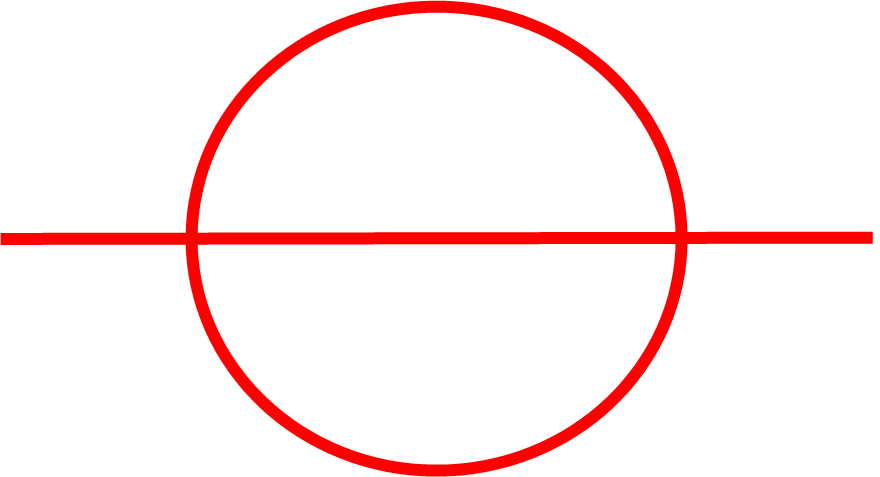
In a lot less words, the sun is a line. The moon, of course, is a fiery circle. The implication is pretty interesting for two reasons. First, I draw your attention back to Theorem I from Monas Hieroglyphica:
It is by the straight line and the circle that the first and most simple example and representation of all things may be demonstrated…
Thus, if the moon is a more circle than fire, the moon and sword piercing it take on this structure:
There's more to it beyond this, though. The alchemical symbol for fire is an equilateral triangle that is pointed upwards. Let's assume for a moment that the moon were more fire than circle and that a sword were piercing it:
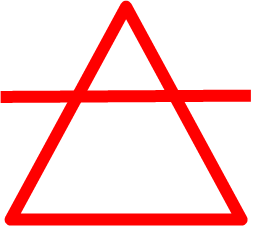
There's a whole tangent I could go on about this, but in a nutshell, I just think it's neat how the receptive moon pierced by the sun can imply Air, "the nourisher of all that breathes."2
Are we God's clothing line?
So we continue to the next phrase:
Which measureth your garments in the midst of my vestures...
Let's be very clear here: QAA is used as "your garments", but let's look at other QA words!
- QAA: garments
- QAAL: creator
- QAAN: creation, as in your creation
- QAAS: also creation, as in your creation
- QAAON: creation, as the phrase in your creation
- QADAH: creator
Clearly we are dealing with metaphor here—garments are not literal garments, they are the fabric of reality or the threads of creation.
The metaphor doesn't end there. Consider also:
Which measureth your garments in the midst of my vestures...
"Vestures" is just another word for clothing, so in a way it's like saying, "I'm measuring your clothing in the midst of my clothing." If we start replacing words either with their metaphorical counterparts, we start getting things like "Which measures your substance in the midst of my substance." This could mean a few things:
- God is measuring the fabric they're wearing and saying, "This be you now."3
- God is measuring separate clothing that they mixed in with their laundry.
- God is quantifying and counting how much of their fabric we get to have.
(2) assumes that we're separate from God. As I'll show in the Second Key, this is absolutely not the case—we're looking at a monistic, panentheistic view of reality. (1) and (3) run pretty close together, but with the way I wrote them they still tend to separate the Self from the Divine Other—which is not what's going on here.
The thing that I think is interesting about (3) is if the sun and moon are the air we breathe, and air is often equated to life (consider the expression "their last breath"), we end up with this idea of how much life we are measured to have.
Fiber arts puns are inevitable tie-ins in the First Key
... and trussed you together as the palms of my hands, whose seats I garnished with the fire of gathering, and which beautified your garments with admiration.
First note: "trussed" means "to tie tightly". Given that garments are made of string (which is kind of a line when laid out straight), weaving them together to form actual being together. Humanity is not in isolation; we are not unlike clothing in that we are parts of a whole.
The phrase "whose seats" means our place in creation, and "fire of gathering" is the receptive element, like the moon, where we are lines tied together as part of the fabric of reality.
Enough about clothing, let's talk about contracts
... you lifted up your voices and swore obedience and faith to him... whose beginning is not nor end cannot be, which shineth in the midst of your palace and amongst you as the balance of righteousness and truth.
Really, all I wanted to say here is that apparently humanity pledged to live in alignment with God at some point. Not sure when this happened, but here we are apparently.
Also, the pedant in me wants to point out that "the balance of righteousness and truth" means one of two things:
- Truth and Righteousness as balanced against other stuff
- The balance between Righteousness and Truth
The former I can get, but that's not what the grammar implies; what the text is suggesting is that righteousness is not always true, and truth is not always righteous.
I haven't decided what to make of this just yet—if I come upon anything meaningful and think to edit this, I'll be sure to include it, but for now, I leave it as food to chew on.
First Key takeaways
So that's how reality is a thing in Enochian cosmology. I decided to not perform any kind of analysis of the charge to whatever is invoked by the psalm-esque passage, but I don't think it's necessary for what we're doing here.
Anyway thanks for reading okay byeee!
Click here to go to the next article.
Footnotes
Do not let it be lost on you that the word-play here works for both Enochian and English—this is one of the more subtle cues that Enochian is derived more from English than anything else. ↩
Not Dee and Kelly, but Crowley writes in as part of the Creed in the Gnostic Mass when talking about the sun: "I believe in one secret and ineffable LORD; and in one Star in the Company of Stars of whose fire we are created, and to which we shall return; and in one Father of Life, Mystery of Mystery, in His name CHAOS, the sole viceregent of the Sun upon the Earth; and in one Air the nourisher of all that breathes." This is decidedly in alignment with the notion here: there is fire, and through the creative force of the sun, we have air, which nourishes us all. Just kind of an interesting tangent that I thought I'd include. ↩
You could almost read this as saying that God and humans are cut from the same cloth. ↩